Hero10 Black Specs, Features, and Value: Is it worth the price tag?
The GoPro Hero10 Black arrived as a performance-focused iteration in GoPro's flagship line, targeting shooters who need higher frame rates, faster responsiveness, and more reliable stabilization than previous generations. This article examines the Hero10 Black's specifications and real-world capabilities, analyzes how those features serve common use cases, compares the camera to a couple of close competitors, and offers a practical buying guide to help determine whether the Hero10 represents good value for different types of buyers.
Introduction
Action cameras are judged by their ability to deliver smooth, usable footage in challenging environments: high motion, variable light, water, dust, and jostling mounts. The Hero10 Black doubled down on GoPro's strengths — rugged build, strong mount ecosystem, and polished software — while introducing a newer processor to push higher frame rates and make the camera feel snappier in daily use. Buyers considering the Hero10 typically ask: how much better is it than the previous model, does the higher frame rate and responsiveness justify the price, and how well does it fit into real workflows (editing, battery life, accessories)? This review addresses those questions with a focus on practical, real-world use.
Core Specifications Overview
| Specification | Hero10 Black |
|---|---|
| Processor | GP2 (GoPro's second-generation custom processor) |
| Max Video Resolution & Frame Rates | Up to 5.3K at 60fps; 4K up to 120fps; high-frame-rate 2.7K/1080p modes for slow motion |
| Photo Resolution | Up to 23MP stills with RAW capture capability |
| Image Stabilization | Next-generation HyperSmooth (improved electronic stabilization and in-camera horizon leveling) |
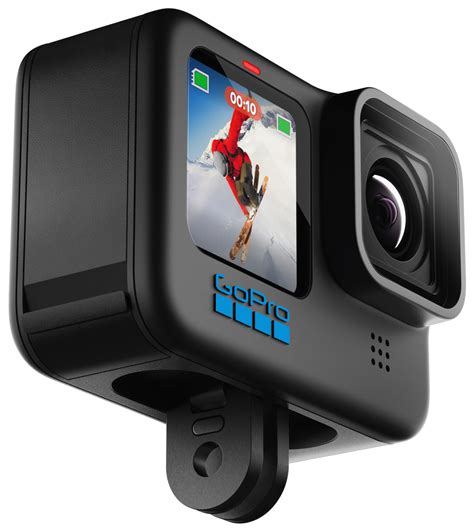
| Display | Rear touchscreen + front status/preview screen |
| Durability | Rugged, waterproof to 10 meters (33 feet) without housing |
| Connectivity | Wi‑Fi, Bluetooth, USB-C for power and data |
| Storage | microSD card (UHS-I/U3 or better recommended) |
| Battery | User-replaceable rechargeable battery; compatible with GoPro's Enduro batteries for improved cold-weather performance |
| Formats | HEVC (H.265) and H.264; stills in JPEG and RAW |
Detailed Feature Analysis
Performance and Responsiveness
The Hero10's GP2 processor is a central upgrade: it allows higher frame rates, faster menu navigation, quicker offload and transfer times, and generally snappier handling. For users who frequently swap settings mid-activity — for example switching from a wide 5.3K recording to a high-frame-rate 2.7K slow-motion clip — the improved responsiveness reduces the risk of missing critical moments. The touchscreen and front preview remain quick and intuitive, which matters when adjusting settings on the fly during a surf session, mountain bike run, or skatepark shoot.
Video Capabilities & Image Quality
Higher-resolution capture (5.3K) and faster frame rates (4K at high fps) translate directly to more flexible post-production: more headroom for cropping, stabilization, and reframing without losing detail. For action filmmakers and content creators who crop or reframe shots for social formats, that extra resolution is valuable. The camera's color science and HDR modes produce punchy, contrast-rich footage straight out of camera, while offering a flat (or “Protune”) profile for those who prefer to grade in post.
Low-light performance is acceptable for an action camera but cannot match larger-sensor mirrorless or DSLR cameras. In dim conditions, noise becomes more noticeable, so buyers who frequently film at night or in indoor low-light scenarios should temper expectations and consider external lighting or different camera types for those specific shoots.
Shop the latest Electronics picks on Amazon.
Shop Amazon →Stabilization and Motion Handling
GoPro's stabilization has long been a headline feature. The Hero10 advances the electronic stabilization engine, delivering steady footage when used with helmets, chest mounts, or handlebar setups. The horizon leveling feature helps keep shots visually stable even when the camera rotates aggressively, which is useful for POV sports. While mechanical gimbals still provide the smoothest motion for cinematic pans and tilts, the Hero10's stabilization is excellent for compact, lightweight setups where a gimbal would be impractical.
Sound and Voice Control
Built-in microphones capture usable audio for many scenarios, though wind and ambient noise can be problematic at high speeds. GoPro's wind-reduction algorithms help but are not a substitute for external mics when audio fidelity is critical. Voice control remains handy for hands-free starts and stops; it works reliably most of the time outdoors and underwater when commands are clear.
Battery Life and Thermal Management
Higher processing power and high-bitrate recording do increase thermal output and battery consumption. In practical terms, expect shorter continuous record times when shooting at the highest resolutions and frame rates compared with lower-resolution presets. Swapping to the optional Enduro battery and carrying spares is a common practice among heavy users. Additionally, in hot environments or during extended 4K/5K recording, the camera can throttle to manage temperature, which is normal for compact action cameras pushing intensive workloads.
Software and Ecosystem
GoPro's companion app and desktop workflows continue to be a strength: quick transfers, automatic highlight detection, and simple editing templates make producing quick social clips easy. The Hero10 also fits into the broad GoPro accessory ecosystem — mounts, housings, and media mods — which remains one of the camera’s biggest practical advantages.
Discover deals on Electronics — updated daily.
Browse Now →Real-World Use Cases
- Adventure and extreme sports: Mountain biking, skiing, surfing, and skydiving benefit from the Hero10’s ruggedness, stabilization, and high-frame-rate options for slow-motion replays.
- Travel and vlogging: The front preview screen and compact form factor make the camera convenient for on-the-go vlogging where a light-weight setup is important.
- Motor sports and POV shots: The robust mount options and stabilization make it a reliable choice for helmets, handlebars, and vehicle mounts.
- Action filmmaking and B-roll: Creators who need high-frame-rate, high-resolution B-roll to integrate into larger projects will appreciate the 5.3K capture and flexibility in post.
- Underwater snorkeling and shallow diving: Waterproof capability without housing is ideal for casual underwater footage; for deeper dives, an appropriate housing is still necessary.
Pros & Cons
Pros
- Excellent stabilization for a camera of its size, making handheld and mounted footage look usable without external gimbals.
- High-resolution capture and high frame rates provide flexibility for editing, cropping, and creating slow-motion footage.
- Rugged, waterproof design suitable for outdoor use without additional housing to moderate depths.
- Fast, responsive interface and improved transfer speeds due to the upgraded processor.
- Strong accessory ecosystem and well-integrated app/software workflows for quick editing and social sharing.
Cons
- Battery life can be limiting at the highest settings; heavy users will want spare batteries or Enduro replacements.
- Electronic stabilization is excellent but does not fully replace mechanical gimbals for cinematic movement.
- Low-light performance lags behind larger-sensor cameras; noise is noticeable in dark scenes.
- Higher price point compared with entry-level or older action camera models, which can be a barrier for casual users.
How the Hero10 Compares (At-a-Glance)
| Model | Max Video | Stabilization | Best For | Typical Buyer |
|---|---|---|---|---|
| Hero10 Black | 5.3K / 60fps; 4K / 120fps | Advanced electronic (HyperSmooth) | High-frame-rate action, flexible editing, rugged use | Enthusiast and professional content creators who need top-tier action cam performance |
| Hero9 Black | 5K / 30fps; 4K / 60fps | Very good electronic stabilization | All-around action use with slightly lower frame rates | Users who want strong performance for slightly less money |
| Competitor (compact action) | Typically up to 4K / 60–120fps | Varies; solid on some models, less refined on others | Compact POV filming, budget-conscious buyers | Casual users, travel vloggers on a budget |
Buying Guide: Is the Hero10 Right for You?
Deciding whether the Hero10 Black is worth the price comes down to matching features to intended use. The camera is a compelling choice for users who need the specific benefits it provides; for others, the older model or a competitor may be a better value.
Who should consider the Hero10?
- Those who prioritize high frame rates for slow motion and want to crop/reframe without losing too much detail.
- Action sports enthusiasts and professionals who need the best-in-class stabilization without bulky rigs.
- Content creators who rely on quick turnaround — the faster processor and app integration speed up the editing workflow.
- People invested in the GoPro accessory ecosystem who benefit from compatibility with mounts, mods, and batteries.
Who might skip it?
- Casual users who rarely shoot at high frame rates or don’t need 5K resolution — a previous-generation camera can be more cost-effective.
- Filmmakers who prioritize low-light performance and shallow depth-of-field — larger-sensor mirrorless cameras are better suited.
- Buyers for whom battery life is critical and who do not want to carry spare batteries or invest in power accessories.
Practical advice when buying
- Consider real use: if most footage ends up online at 1080p, prioritize stabilization and ease of use over the latest resolution numbers.
- Budget for at least one spare battery and a fast microSD card to avoid interruptions during long shoots.
- Check the accessory ecosystem you need (mounts, housings, media mods) and factor those costs into the overall purchase decision.
- For heavy editing workflows, ensure a computer and storage solution can handle large high-bitrate files comfortably.
Tips for Getting the Most Out of a Hero10
- Match resolution and frame rate to the final deliverable. Use higher fps only when slow motion is needed to save storage and battery life.
- Use stabilization and horizon leveling for POV shots; turn it off when using a gimbal for maximum control and battery efficiency.
- Enable Protune (flat color profile) when planning to color grade; otherwise use the default color for quick, out-of-camera uploads.
- Keep firmware updated: GoPro frequently releases optimizations that improve stability, performance, and features.
- Carry a small kit of spare batteries, a card reader, and a compact charger for multi-day adventures.
Conclusion
The Hero10 Black is a purposeful upgrade within the GoPro lineup: its faster processor, higher frame rates, and refined stabilization serve creators who demand flexibility and durability. For those who film dynamic sports, produce short-form content with frequent reframing needs, or rely on a compact, mountable camera system, the Hero10 delivers tangible benefits that justify its premium for many buyers.
However, buyers with more casual needs, or those whose priorities are low-light sensitivity or maximum battery endurance, may find better value in older models or alternative camera types. As always, evaluating the camera against specific workflows — editing, battery logistics, and the required accessory set — will give the clearest answer to whether the Hero10 Black is the right investment.