The Truth About the Hoka Speedgoat 7: Pros, Cons, and Verdict
The intersection of outdoor adventure and high-performance engineering has reached a peak in recent years, but the announcement of the Hoka Speedgoat 7 marks a significant shift in how trail runners and hikers perceive technical footwear. Long regarded as the "King of the Trails," the Speedgoat series has consistently set the benchmark for cushioning, traction, and durability. However, as the industry moves toward more specialized materials and precise geometric designs, the seventh iteration of this iconic silhouette faces the difficult task of satisfying long-time loyalists while attracting a new generation of athletes who demand more than just a soft ride. This article explores the intricate details of the Speedgoat 7, dissecting its structural changes, its performance on varied topography, and the specific engineering choices that define its place in the current market.
The Evolution of a Trail Icon
To understand the Speedgoat 7, one must acknowledge the legacy of its predecessor. The series was originally inspired by Karl "Speedgoat" Meltzer, the world record holder for most 100-mile ultra-marathon wins. Since its inception, the design philosophy has remained centered on "maximalist" protection. While early versions were criticized for being somewhat narrow or unstable on high-camber turns, subsequent models refined the fit and the platform. The Speedgoat 7 represents the most aggressive departure from the traditional foam compounds used in earlier versions, introducing a proprietary supercritical midsole that aims to provide energy return without the "mushy" feel sometimes associated with high-stack shoes.
For the average trail runner, the Speedgoat has always been a reliable companion for long-distance efforts where fatigue management is the primary goal. In this new version, the emphasis has shifted slightly toward agility. By tapering the heel and widening the forefoot base, the designers have attempted to solve the historic "tippiness" of the shoe. This section explores how these refinements translate to real-world performance on everything from groomed fire roads to technical, root-choked singletrack.
Upper Construction and Breathability
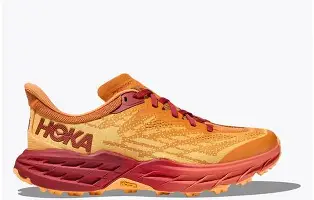
The upper of the Hoka Speedgoat 7 is constructed from a reinforced double-layer jacquard mesh. This material is intentionally engineered to provide structural integrity in the midfoot while allowing the toes to splay and breathe during high-intensity efforts. Many users find that trail shoes often fail at the flex point—the area where the foot bends during the toe-off phase. Hoka has addressed this by incorporating 3D-printed overlays that bolster the mesh without adding significant weight or stiffness. This ensures that the shoe maintains its shape over hundreds of miles of use.
Furthermore, the tongue has been revised once again. In earlier models, the "winged" or gusseted tongue was sometimes prone to sliding or causing pressure points on the dorsal aspect of the foot. The Speedgoat 7 utilizes a thinner, more anatomical tongue that sits flush against the skin, distributing lace pressure evenly. This is particularly beneficial for runners who prefer a "locked-in" feel when descending steep technical terrain, where any internal foot movement can lead to blisters or blackened toenails.
Midsole Dynamics and Cushioning
The heart of any Hoka shoe is the midsole, and the Speedgoat 7 is no exception. It features a reworked CMEVA (Compression Molded Ethyl Vinyl Acetate) foam that is significantly lighter than the foam used in the Speedgoat 5 or 6. By utilizing a new chemical formulation, the foam provides a more responsive "pop" during the transition phase of the gait cycle. This addresses a common critique that previous models felt somewhat sluggish during faster tempo runs.
The stack height remains substantial, offering the signature underfoot protection that allows runners to glide over sharp rocks and debris without feeling the impact. This "hover" sensation is what has made the Speedgoat popular among hikers as well as runners. When carrying a heavy pack, the impact of each step is magnified; the Speedgoat 7 absorbs this kinetic energy, reducing joint stress on the knees and hips over high-mileage days.
Detailed Performance Analysis
When assessing the Speedgoat 7, it is essential to look at how it performs in different environments. Trail shoes are rarely "all-rounders" in the truest sense, but Hoka attempts to bridge the gap between a daily trainer and a technical racer. On soft, muddy terrain, the shoe shines due to its outsole. On hard-packed, dusty trails, the midsole's vibration dampening becomes the standout feature.
Traction and Outsole Engineering
The outsole leverages Vibram® Megagrip with Traction Lug technology. This is not merely a marketing term; the 5mm lugs feature tiny micro-textures that increase surface area, allowing for better grip on smooth, wet surfaces like river rocks or mossy logs. The lug pattern is multidirectional, with "chevron" shapes oriented to provide braking power in the heel and propulsion power in the forefoot. During testing on steep descents, the "braking" lugs significantly reduce the risk of a slide-out, providing the runner with the confidence to maintain speed even when the grade exceeds twenty percent.
Shop the latest Electronics picks on Amazon.
Shop Amazon →Durability of the outsole is another key factor. Traditional soft rubbers provide great grip but wear out quickly on abrasive granite or pavement connectors. The Megagrip compound used in the Speedgoat 7 strikes a balance, offering long-term wear resistance without sacrificing the "sticky" quality required for scrambles.
Stability and Ground Feel
One of the inherent trade-offs of a maximalist shoe is the loss of ground feel. If you cannot feel the trail beneath you, your proprioception is compromised, which can lead to rolled ankles. The Speedgoat 7 mitigates this via its "Active Foot Frame." Rather than sitting on top of the foam, the foot sits slightly inside the midsole, which acts like a bucket seat in a race car. This keeps the heel centered and prevents lateral shearing. While you will never get the "minimalist" connection of a low-profile shoe, the Speedgoat 7 feels surprisingly planted, even on uneven scree fields.
Pros and Cons
Every piece of technical gear involves compromise. The Speedgoat 7 is a highly refined tool, but it is not the perfect shoe for every foot type or every trail condition. Below is a breakdown of the primary advantages and drawbacks observed during extensive use.
- Pro: Exceptional Cushion-to-Weight Ratio. Despite the massive amount of foam underfoot, the shoe remains incredibly light, making it suitable for both short races and multi-day treks.
- Pro: Industry-Leading Traction. The Vibram® Megagrip outsole continues to be the gold standard for wet and dry grip.
- Pro: Improved Toe Box Room. Hoka has listened to feedback regarding narrow fits, providing a slightly more voluminous forefoot that accommodates natural foot swelling.
- Pro: Durability. The use of reinforced jacquard mesh and 3D overlays prevents premature tearing in high-stress areas.
- Con: Steep Price Point. The advanced materials and licensing of Vibram technology make this one of the more expensive options in the trail category.
- Con: Muted Ground Feel. Runners who prefer to feel every pebble and contour of the trail may find the cushioning too isolating.
- Con: Break-in Period. The new foam compound can feel slightly firm out of the box, requiring 20-30 miles to reach its optimal softness.
Comparison with Leading Competitors
To provide a clearer picture of where the Speedgoat 7 sits in the marketplace, it is helpful to compare it against other high-end trail shoes. The following table summarizes how the Speedgoat 7 stacks up against its primary rivals in terms of key performance metrics.
| Feature | Hoka Speedgoat 7 | Saucony Peregrine 14 | Altra Lone Peak 8 |
|---|---|---|---|
| Primary Use | Technical Trails / Ultra Mid-Distance | Fast / Aggressive Technical | Natural Gait / Thru-Hiking |
| Cushioning Level | Maximalist | Moderate/Firm | Balanced/Natural |
| Drop (Heel-to-Toe) | 4mm | 4mm | 0mm |
| Outsole Brand | Vibram® Megagrip | PWRTRAC | MaxTrac |
| Weight (Approx.) | 290g (Men's 9) | 267g (Men's 9) | 314g (Men's 9) |
Buying Guide: Is the Speedgoat 7 Right for You?
Choosing a trail shoe is a highly personal decision that depends on your anatomy, your experience level, and the specific terrain you frequent. When considering the Speedgoat 7, you should ask yourself several critical questions to determine if this investment aligns with your athletic goals.
Assess Your Terrain
If your local trails consist mostly of flat, paved paths or very smooth gravel, the Speedgoat 7 might be "too much shoe." Its deep lugs and aggressive traction are designed for loose dirt, mud, and vertical climbing. Conversely, if you spend your weekends on rocky ridges or descending steep canyons, the protection offered by the Speedgoat's stack height is almost indispensable. The shoe acts as a shield against sharp obstacles that would otherwise cause foot fatigue or bruising.
Consider Your Foot Shape
While the Speedgoat 7 is more accommodating than past versions, Hoka shoes generally have a distinct arch profile and a "meta-rocker" geometry. This means the sole is curved to encourage a rolling motion. If you have very flat feet or if you prefer a traditional flat-soled shoe, the rocker might feel unnatural at first. It is always recommended to try these on in an editorial or retail setting where you can walk on an incline to see how the heel lock performs.
Volume and Mileage
Are you training for a 5K or a 100-miler? For shorter, faster efforts, you might prefer a shoe with more ground feel and less weight. However, for anything over the two-hour mark, the benefits of maximalist cushioning become apparent. The Speedgoat 7 excels at "saving your legs." By reducing the muscular vibration caused by impact, it allows you to maintain better form late into a long run, which can be the difference between a successful finish and an injury-plagued "did not finish" (DNF).
Find top-rated Electronics products at great prices.
Browse Now →Technical Deep Dive: The Science of the "Meta-Rocker"
A significant part of the "Truth" about the Speedgoat 7 lies in its geometry. Hoka utilizes what they call a "Late Stage Meta-Rocker." This means the fulcrum point of the curve is placed closer to the toes rather than the midfoot. The purpose of this design is to support the natural gait cycle while providing a smooth transition from landing to push-off. In technical trail running, where your stride length is constantly changing to accommodate obstacles, the rocker helps maintain momentum.
Additionally, the "Late Stage" rocker is particularly helpful for those with limited ankle mobility. Because the shoe handles a portion of the mechanical work of "rolling" the foot forward, it places less strain on the Achilles tendon and the calf muscles. This has made the Speedgoat 7 a favorite among older athletes or those recovering from lower-leg injuries who still want to stay active on the trails.
Sustainability and Material Innovation
In the modern era of footwear, performance is no longer the only metric—environmental impact matters. The Speedgoat 7 incorporates a significant percentage of recycled polyester in its upper mesh. Moreover, the laces and the internal heel counter are derived from post-consumer materials. While the footwear industry still has a long way to go toward true circularity, Hoka’s commitment to reducing virgin plastics in its flagship models is a step in the right direction. For the conscious buyer, knowing that their high-performance gear isn't coming at a total cost to the environment is a major selling point.
The manufacturing process of the supercritical foam also involves fewer volatile organic compounds compared to traditional EVA pouring methods. This results in a "cleaner" foam that is not only lighter and more durable but also marginally better for the planetary footprint. As consumers increasingly prioritize brands that demonstrate corporate responsibility, these technical details become just as important as the lug depth or the colorway.
Maintenance and Longevity Tips
To get the most out of an investment like the Speedgoat 7, proper care is essential. Trail shoes are subjected to harsh conditions—alkaline mud, abrasive sand, and constant moisture. Over time, these elements can degrade both the mesh and the foam. To extend the life of your shoes, never wash them in a commercial washing machine, as the heat and agitation can break down the adhesives and the midsole structure. Instead, use a soft brush and cool water to remove debris after each run.
Storing the shoes in a cool, dry place away from direct sunlight is also vital. UV rays can make the foam brittle over time, leading to premature cracking. If you run in wet conditions frequently, stuffing the shoes with newspaper to absorb moisture will help maintain the shape of the upper and prevent the growth of odor-causing bacteria. Most users can expect between 400 and 500 miles out of a pair of Speedgoat 7s, depending on their weight and the aggressiveness of their terrain.
Conclusion
The Hoka Speedgoat 7 remains a powerhouse in the trail running world, successfully evolving to meet the demands of modern athletics while staying true to its maximalist roots. The combination of the lightweight, responsive midsole and the unrelenting grip of the Vibram® Megagrip outsole creates a platform that is as capable of winning world-class races as it is of providing comfort for a casual weekend hiker. While the reduced ground feel and premium pricing may be a deterrent for some, the sheer volume of protection and the refined fit make it one of the most versatile shoes on the market. Whether you are navigating the slippery roots of the Pacific Northwest or the sun-baked granite of the Sierras, the Speedgoat 7 offers a level of confidence and comfort that few competitors can match. It is a testament to how far footwear engineering has come, proving that you don't have to sacrifice speed for safety, or durability for weight. For those who prioritize long-term foot health and consistent performance across diverse landscapes, the truth is simple: the Speedgoat 7 still deserves its crown.